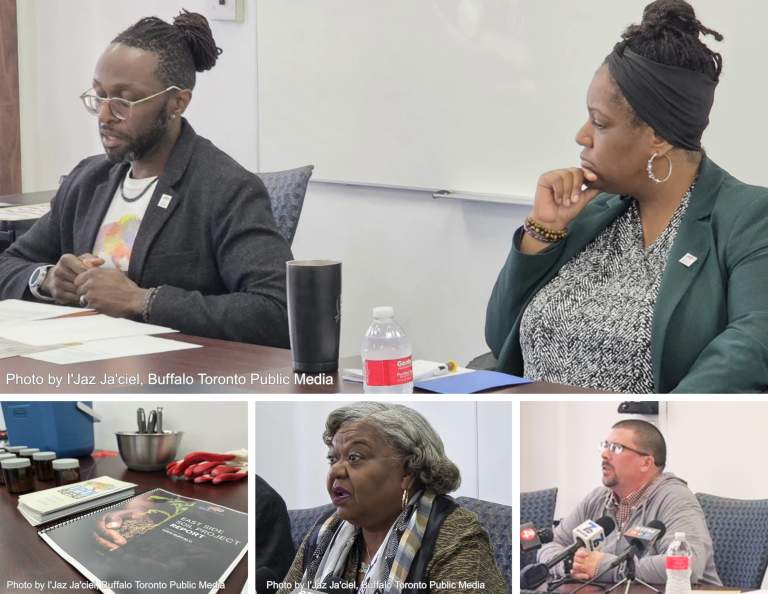
Alongside NYS DEC representatives, Open Buffalo Releases Report, Recommendations, and Referral to U.S. EPA Regarding Lead Soil Contamination on East Side
Published March 31, 2026
BUFFALO, N.Y. – Today, after months of community outreach, analysis, and research, Open Buffalo was proud to release its East Side Soil Project Report (2026). Open Buffalo held a press conference with representatives from the New York State Department of Environmental Conservation (DEC) to discuss findings from Open Buffalo’s “East Side Soil Project” and referral to the U.S. Environmental Protection Agency (EPA) for further inquiry.
Open Buffalo’s “East Side Soil Project” was the first widespread effort to understand the scope of lead contamination on East Side residential properties. The average amount of lead in the properties tested was more than three times higher than what the EPA considers safe for everyday contact (200ppm). This study further underscores the compounding and disparate environmental threats faced by East Side residents.
“East Side residents have long dealt with disparate socioeconomic realities, environmental racism, and daily exposure to deadly toxins carried through the air, water, and soil,” said Franchelle Parker, Executive Director of Open Buffalo. “We recognize that lead-contaminated soil is only one of many contributing factors to many of the health and academic challenges facing residents and, moreover, that such problems can be found in other parts of the city as well. Our long-term goal is to explore strategies to mitigate the harm caused by toxins such as lead and build a coalition of likeminded residents, organizations, and government partners to address the inequitable burden of such environmental injustice.”
From June 2025 through October 2025, Open Buffalo collected 249 composite samples from 138 properties using standardized EPA collection procedures. Testing was conducted by an independent lab using EPA testing protocols. The results were alarming.
Bearing in mind the EPA’s action level of 200ppm, the average lead level in the soil from the 249 samples we collected was 642ppm. Nearly 70 percent of the properties tested were above 400ppm, and there were two clusters of properties, in close proximity to a school, that averaged 1,842ppm.
These results are even more concerning given that East Side residents are already at a heightened risk of exposure to lead, and elevated blood lead levels, from lead paint in homes and from drinking water delivered through lead service lines.
Open Buffalo was able to complete the East Side Soil Project with the support of an environmental justice grant from the state DEC. Upon receiving the East Side Soil Project report from Open Buffalo recently, the DEC also made an official referral to the EPA for inquiry into community lead contamination.
“DEC’s Community Impact Grants support the crucial work of people on the ground working tirelessly to lift up their communities and provide a healthier, more sustainable future,” DEC Office of Environmental Justice Director Alanah Keddell-Tuckey said. “DEC remains committed to supporting organizations like Open Buffalo to address environmental harms and health hazards that communities face in New York. DEC looks forward to ongoing communication and collaboration on environmental issues that impact the East Side."
A majority of soil samples that were collected and analyzed were from properties in Buffalo’s Masten District. We are grateful for the attention of guidance of Masten Common Councilmember and Council President Pro Tempore Zeneta B. Everhart over the past year. Said Everhart upon the ESSP report release, “I want to express my gratitude to Open Buffalo, Citizen Science Community Resources, and faculty from the University at Buffalo’s Department of Environment and Sustainability for conducting this study. We cannot deny that the soil test results are extremely disheartening. The soil is just one of many different factors that have aided in critical health issues. I stand with Open Buffalo in combating this issue, and I am calling on our partners in government at the state and federal levels to take this report seriously and help aid residents through this growing health crisis. There is a path forward and we must work together to ensure the safety of all residents across the city of Buffalo.”
Deborah Fugate, a resident of Buffalo’s historic Hamlin Park neighborhood and avid gardener, chose to have her property tested for lead. “I wanted to know, ‘What's in there?’” Fugate said. “So, when [Open Buffalo] did the testing and I got the results, I was really surprised, knowing that all this lead is in my soil. So, I went from growing my potatoes in the ground to growing them in a bag. Because that way I can control what they're growing in.” Beyond her personal gardens and living space, Fugate said about community lead contamination concerns, “I don’t want to see child sick. I’ve seen a child sick from lead poisoning, and it’s very scary.”
East Side residents face a number of environmental threats stemming from legacy toxins in the water and soil from Buffalo’s industrial past and ongoing exposure to carcinogens from vehicle exhaust from traffic on the Kensington Expressway. The combination of these toxic pollutants has placed East Side residents at a demonstrably increased risk of health problems, including lupus, heart and kidney disease, learning disabilities and developmental delays, and a lower life expectancy.
Turning Toward Solutions
Visit www.openbuffalo.org to view the ESSP in-depth results along with background, context, and recommendations to make Buffalo a safer place to raise a family.
Three of those recommendations include:
- Creation of a City Ecological Justice Oversight Board.
- Comprehensive testing and mapping of soil contamination in Buffalo.
- Dedicating public funding for residents looking to remediate their properties.
Open Buffalo is grateful for productive partnerships in local and state government, and remains committed to advancing the truth about environmental conditions in Buffalo, and solutions to remove as many environmental health hazards as possible.
Check out press coverage from our event here:
'Results were alarming': High lead levels found in soil outside homes on Buffalo's East Side
Open Buffalo's East Side Soil Project report reveals high lead contamination levels
EPA to review high lead levels in Buffalo soil
https://www.wivb.com/news/local-news/buffalo/epa-to-review-high-lead-levels-in-buffalo-soil/
Alarming soil report leads to mounting calls for ecological justice on Buffalo's east side
About Open Buffalo
Open Buffalo is a non-profit (501c3) organization dedicated to advancing racial, economic, and ecological justice. We believe that an understanding of the interdependence between all living things is a crucial step toward protecting the global climate and its delicate ecosystems to ensure that marginalized communities have uninhibited access to quality air, water, and food.
###