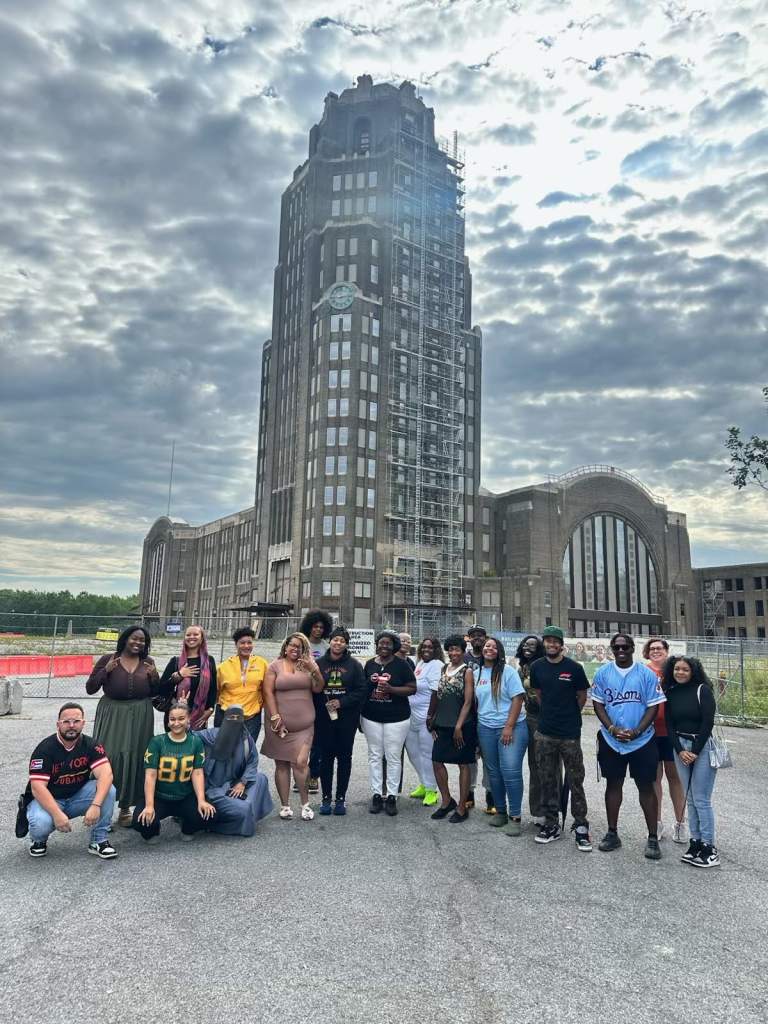
Emerging Leaders Tour Highlights Buffalo’s History, Neighborhoods and Justice Movements
Published September 1, 2026
Open Buffalo’s Emerging Leaders Class of 2026 spent Saturday, Aug. 22, touring Buffalo neighborhoods and landmarks to examine how public policy, infrastructure decisions and community organizing have shaped the city.
The eight-hour tour began near Open Buffalo’s Jefferson Avenue office before moving through Cold Springs and Broadway-Fillmore. At Central Terminal, participants discussed the long-delayed plans to redevelop the landmark into a nonprofit and business hub. We also examined nearby “telescope houses,” a unique Buffalo architectural phenomenon so-called for their telescoping rear additions built to expand the industrial starter homes built on long, narrow lots. We also discussed contemporary organizing efforts around a former community center now tied to competing city plans for either an indoor police shooting range or a new animal shelter.
The group then visited the future Open Buffalo Urban Ecology Campus and Climate Resilience Hub off Broadway, a 10-acre site envisioned as a green space for gathering, learning, outdoor recreation, and shelter during extreme weather events. Our participants enjoyed the positive experience of walking through this slice of nature reclaimed from an industrial past.
Traveling from MLK Park along the Kensington and Scajaquada expressways, cohort members considered the division of Hamlin Park and the loss of neighborhood institutions like a hospital and a community center following the demolition of Humboldt Parkway. One of the participants, who grew up on Humboldt Parkway, shared her childhood experience of witnessing the destruction in her community. At the Buffalo History Museum, Executive Director Melissa Brown and Library and Archives Coordinator Alex Dowrey introduced materials documenting local justice movements.
After lunch, the group traveled through the West Side, discussed Eco Justice projects and PUSH Buffalo’s housing justice work, and visited Freedom Park, where Sabriyah Lailla Smith of the 2024 Emerging Leaders cohort led a libation ceremony honoring freedom seekers who crossed the Niagara River and the many who perished in the swift-flowing waters as they tried to cross.
The tour continued down Niagara Street past the future Hispanic Cultural Center before stopping in the Michigan Street African-American Heritage Corridor. Ras Jomo Akono led a walking tour highlighting the corridor’s Black-owned institutions, from 19th-century entrepreneurship and labor organizing to WUFO, Buffalo’s first Black-owned radio station.
Stops at Tifft Nature Preserve and South Buffalo broadened the day’s focus to the city’s environmental, immigrant, industrial and labor history.
A new addition this year took participants to the former Pullman Palace Car Company Roundhouse and nearby Palace Car Factory at Broadway and Bailey. There, the class discussed Buffalo’s Black railroad workers, the Pullman Company’s role as a major employer of Black labor, and the racist exclusion of Black workers from the American Railway Union that Union President Eugene V. Debs later argued had weakened the 1894 Pullman Strike. Had the union admitted Black workers, their numbers and solidarity in the strike could have resulted in concessions like higher wages and shorter workdays for workers of all races. Without them, one of the largest strikes in U.S. history ended with federal troop intervention, union leadership jailed, and no concessions for workers.
On the return trip, the cohort passed workforce development sites including Northland Workforce Training Center and Viridi Parente, while discussing Open Buffalo’s soil sampling work, brownfields and barriers to opportunity on the East Side.
The day ended with participants preparing to apply what they learned to their team campaign, issue TBA. Follow us on social media for updates, and to learn what change this year’s cohort will be organizing to win!